






















Braille services
Braille transcription that reads right by touch
Braille transcription and embossing for statements, notices, forms, textbooks, and technical documents. Transcribed to Unified English Braille and BANA standards, proofread by a Braille reader, and delivered on time, so readers who are blind or have low vision get the same information as everyone else.
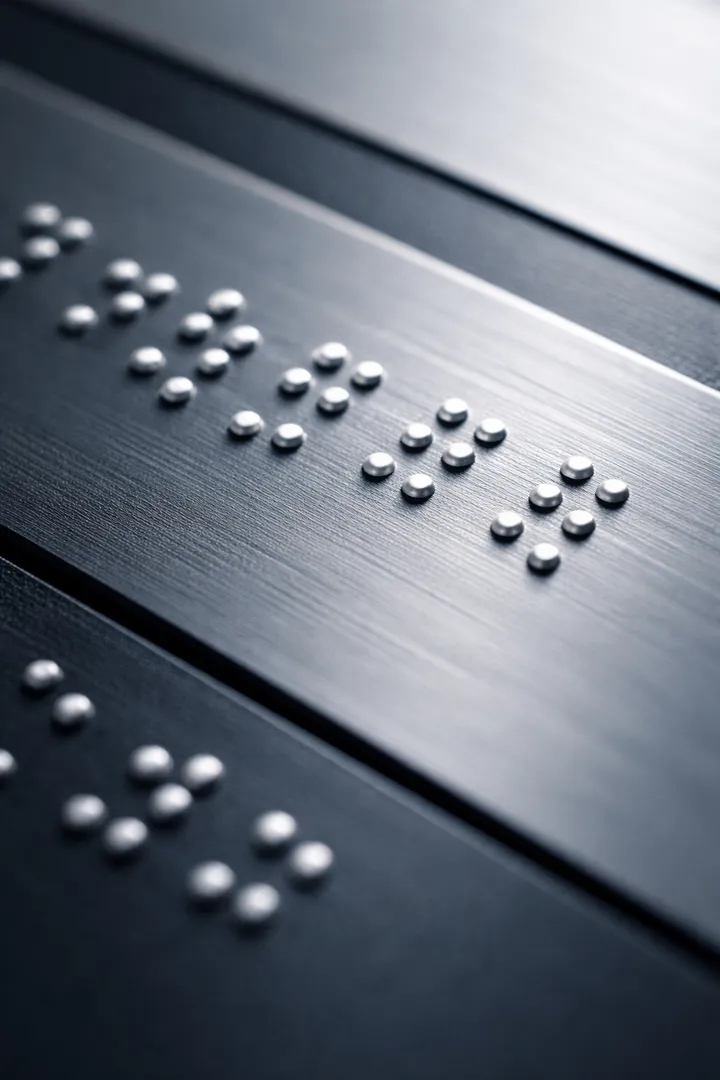
Unified English Braille
Every reader
- UEBUnified English BrailleTranscribed to Braille Authority of North America (BANA) guidelines
- 2-stageProofreadingA sighted transcriber and a Braille-reading proofreader check every file
- 40+Languages in BrailleSo readers who are blind get the same notice in their own language
- 3–5 daysTypical turnaroundFor standard documents, transcribed and shipped. Rush options for urgent notices.
How Braille works
Six dots. Every word.
Braille is read with the fingertips, one six-dot cell at a time. Contracted Braille packs whole words into a single cell, and its rules decide whether a reader understands the page or stops to puzzle it out.
Braille
Uncontracted preview for illustration. Your documents are transcribed in contracted UEB by people, then proofread by a Braille reader.
Why software alone gets Braille wrong
In contracted UEB, these whole words are written as one cell when they stand alone, and not when they are part of another word. A transcriber applies those rules every time.
- knowledge9 cells1 cell
- people6 cells1 cell
- every5 cells1 cell
- you3 cells1 cell
What we transcribe
Every document your readers are owed
If a sighted customer receives it in print, a customer who is blind may need it in Braille, on the same day and with the same detail.
-
Statements and bills
Monthly bank, utility, insurance, and benefit statements, produced on every billing cycle.
-
Notices and policies
Privacy notices, terms, rights notices, and time-sensitive compliance letters.
-
Benefits and enrollment
Plan guides, enrollment forms, and member handbooks that readers act on.
-
Healthcare documents
Patient instructions, consent forms, and care plans, accurate to the word.
-
Math and science
Equations and formulas in Nemeth Code and other technical Braille systems.
-
Other languages
Braille transcription in more than 40 languages, not only English.
Tactile graphics
Charts you can read by touch
A chart that is skipped in Braille is information the reader never gets. Our designers simplify each chart or graph and rebuild it as a raised graphic, with textures in place of colors and Braille in place of print labels, so it conveys the same information as the original.
- Textures, not colors. Each data series gets a texture that fingers can tell apart.
- Braille labels and a key. Titles, axes, and values are labeled in Braille.
- Less clutter. Decoration is removed so the data is easy to find.
Tactile
Our process
From print file to embossed page
Four stages, the same on every project, whether it is one notice or a monthly statement run.
-
Step 1
Expert transcription
Certified transcribers convert your files into Unified English Braille, following BANA standards.
-
Step 2
Tactile graphic design
Charts and graphs are simplified and rebuilt as raised graphics that carry the same information.
-
Step 3
Dual-stage proofing
A sighted transcriber and a native Braille-reading proofreader each check the file.
-
Step 4
Secure production and shipping
Embossed on high-durability paper and shipped through secure, tracked delivery.
Enterprise programs
Recurring statements, every cycle
Banks, insurers, utilities, and agencies send Braille statements every month. Secure automated workflows produce thousands of unique documents per cycle, with each customer’s data protected from intake to delivery.
- 1Data file received
- 2Formatted and transcribed
- 3Proofread
- 4Embossed
- 5Shipped, tracked
Request a quote
Send the file. We’ll send it back in Braille.
Tell us what the document is, how many pages, and how many copies. We confirm the format, the timeline, and the price before any work begins.
Have charts or equations? Mention them. Tactile graphics and Nemeth Code are planned at the start, not added at the end.
Braille requestExample details
- Document
- Annual benefits guide
- Volume
- 48 pages, 25 copies
Related services
More ways to reach every reader
One team for Braille, interpreting, captioning, and translation.
FAQ
Braille services questions, answered
Don’t see your question? A language specialist can answer it in one call.
Talk to a specialist
Get a straight answer
Tell us what you need translated or interpreted, and we’ll scope it with you.
Meet one-on-one with a language services expert, at a time that suits you.
What is Unified English Braille (UEB)?
Unified English Braille is the Braille code for English adopted in the United States, replacing the older English Braille American Edition. It covers literary text and most technical notation, and it is the standard we transcribe to, following the guidelines of the Braille Authority of North America (BANA).
What is the difference between contracted and uncontracted Braille?
Uncontracted Braille, sometimes called grade 1, spells out every letter. Contracted Braille, or grade 2, uses contractions so that common words and letter groups take fewer cells. For example, the word “knowledge” standing alone is written with a single cell. Most adult readers use contracted Braille, and it is our default unless you ask for uncontracted.
Can you handle high-volume, recurring monthly statements?
Yes. We run enterprise-scale recurring programs for statements and notices, using secure automated workflows that produce thousands of unique documents each cycle while keeping every customer’s data protected.
What is the turnaround time for a standard document?
It depends on length and complexity, but most standard business documents are transcribed and shipped within 3 to 5 business days. Rush options are available for time-sensitive compliance notices.
Do you produce Braille in languages other than English?
Yes. We provide Braille transcription in more than 40 languages, so readers who are blind and do not read English receive the same information. If the document still needs translating, we translate it first and then transcribe it.
How do you handle math and scientific formulas?
Technical documents are transcribed by specialists certified in Nemeth Code and other technical Braille systems, so equations, formulas, and symbols are represented precisely. Tell us about math or science content when you request a quote.
What are tactile graphics?
Tactile graphics are raised versions of charts, graphs, and diagrams. We simplify the original, replace colors with textures a reader can tell apart by touch, and label everything in Braille, so the graphic conveys the same information as the print version.
How do you make sure the Braille is accurate?
Every file goes through dual-stage proofing: a sighted transcriber checks it against the source, and a native Braille-reading proofreader reads it the way your reader will. Errors are corrected before anything is embossed.
Is Braille required under the ADA?
Federal ADA rules list Brailled materials among the auxiliary aids that can provide effective communication for people who are blind or have low vision, and Section 504 applies similar duties to organizations that receive federal funds. Whether you must provide Braille depends on your organization and the request, so confirm your obligations with your counsel or compliance team.
How should I send files for Braille transcription?
Send the final version of the document, in its original editable format where possible, through our secure client portal. Let us know the number of copies, the delivery address, and any charts, images, or equations, and we will confirm the format, timeline, and price before work begins.
Tell us what’s at stake. We’ll show you how we’d handle it.
Send your files or describe your event. A language specialist replies with a fixed quote and a delivery date, with no obligation.
Prefer to call? 720-325-0459