






















Software and app localization
Software and app localization that ships with your release
Localize your web app, mobile app, or desktop software without slowing your sprints. We translate strings in context, test the localized build on real devices, and keep every language in step with every release, under ISO 17100 and ISO/IEC 27001 certified processes.
Sound familiar?
Localization shouldn’t be the reason your launch slips
If any of these sound familiar, your localization process is costing you time, money, and users.
Releases wait on translations
The sprint finishes on time, then the global build sits for days waiting for strings to come back.
Strings translated with no context
Translators see “Save” with no screen, so a button becomes a noun in one language and a verb in another.
Longer languages break your UI
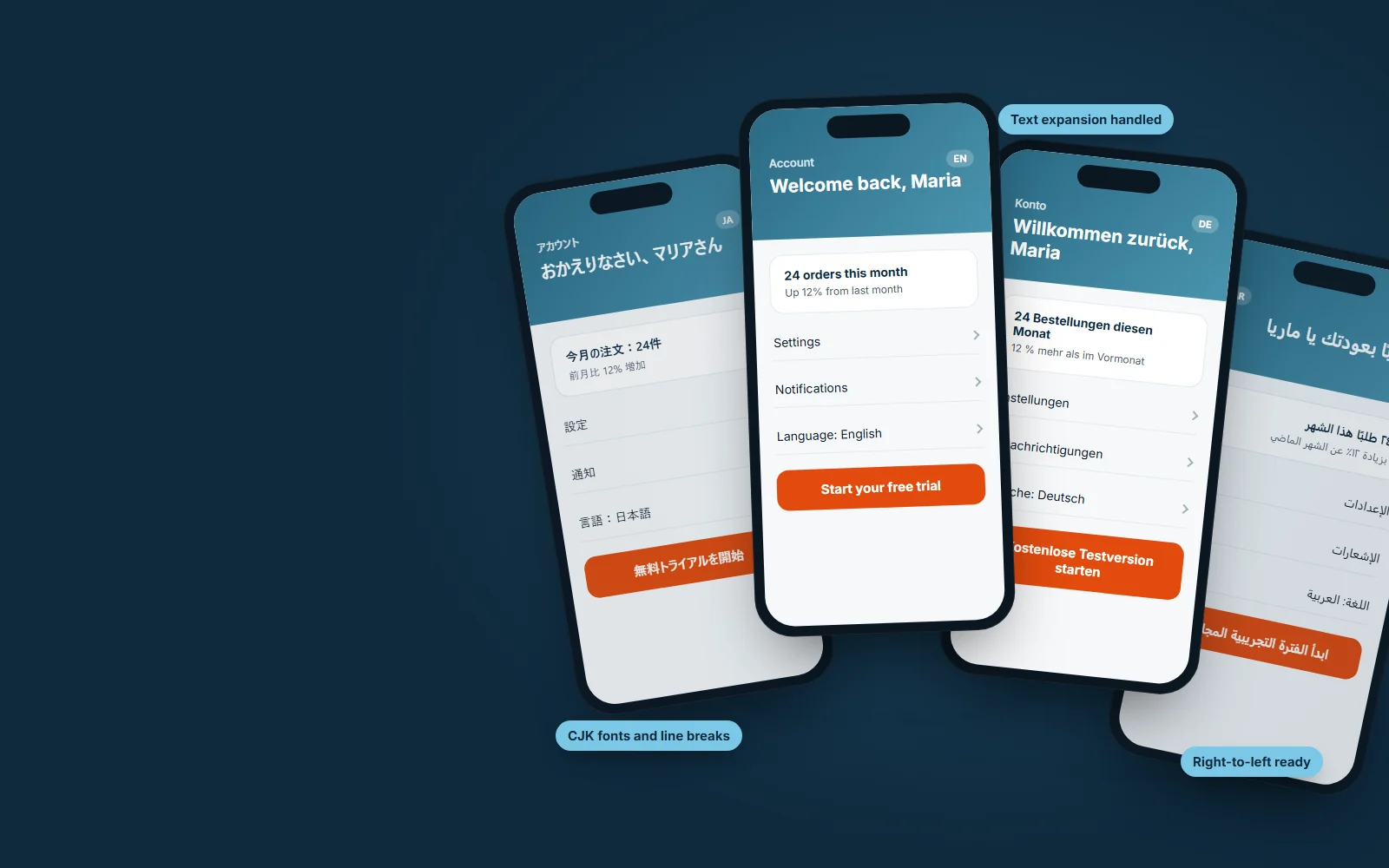
German runs about 30% longer, Arabic reads right to left, and the layout bugs surface after launch.
Terms change from release to release
A feature is called one thing in March and another in May. Users notice, and support tickets follow.
Engineers end up doing QA
Developers screenshot every locale and file translation bugs instead of shipping features.
Unreleased features leave your control
Strings for features you haven’t announced pass through freelancers and public machine translation tools.
What we localize
Everything your users read, tap, and download
One team localizes the product, the content around it, and the listings that bring users in.
Web apps and SaaS platforms
Every screen and message, kept in sync with every deploy.
iOS and Android apps
Native and cross-platform apps with plurals and locale formats done right.
Desktop and enterprise software
Complex, multi-tenant products, from installer to admin console.
App Store and Google Play listings
Researched for how each market actually searches, not translated word for word.
Help centers and documentation
Support content that uses the same terms as your interface.
Legal and compliance text
Translated by legal specialists, so in-product terms hold up in every market.
Launching with a campaign? Our transcreation services adapt your taglines, store descriptions, and ads so they persuade in every market, not just translate.
How it works
A localization workflow built for agile teams
Localization runs alongside development, not after it. Here is how a release moves through it.

- Review internationalization and run pseudo-localizationWe check your code for hardcoded strings, concatenated sentences, plural rules, and date, number, and currency formats, then run a pseudo-localized build that shows where text will truncate before any translation starts.
- Connect your repository and workflowNew strings flow from GitHub, GitLab, or Bitbucket and return as translations in your build. Your project manager tracks work as tickets in Jira or Asana, so localization is visible in your sprint.
- Build your glossary, style guide, and translation memoryProduct terms are approved once and reused in every release. The assets belong to you and can be exported at any time.
- Translate in contextLinguists work from screenshots, string comments, and a live view of the interface, so every word fits its button, menu, and tooltip.
- Test the localized buildWe review language in context and test on real devices and browsers for truncation, overlapping text, fonts, right-to-left mirroring, and locale formats.
- Ship, then keep every language in syncTranslations merge back into your release, and each sprint’s new strings follow the same path, so no market falls a version behind.
Formats and integrations
Works with the files and tools you already use
No new platform to adopt. We work in your resource files and your workflow, and keep code syntax, placeholders, and metadata intact.
Resource file formats
JSONYAMLXLIFF 1.2 and 2.0iOS .strings.stringsdictString Catalogs (.xcstrings)Android strings.xmlgettext .po and .pot.NET .resxJava .propertiesFlutter .arbHTML and MarkdownCSV and XLSX
Repositories and workflow tools
GitHubGitLabBitbucketJiraAsanaYour translation management system
Strings arrive automatically on commit and return to your repository as translations, so nobody emails files.
Industries
Linguists who know your kind of product
We match linguists to your domain, so financial, clinical, and technical terms are right the first time.
- SaaS and enterprise platformsComplex dashboards, permissions, and multi-tenant products.
- Mobile appsMobile-first UI limits and store visibility in every market.
- Fintech and paymentsTrading and banking interfaces, disclosures, and compliance text.
- Health and life sciences softwarePatient-facing apps and regulated content in validated workflows.
- E-commerce and marketplacesCheckout, product data, and support content that converts.
- Games and interactive mediaStorylines, dialogue, and in-game text adapted for each culture.
Security
Your roadmap stays confidential
Localization vendors see features before your customers do. We protect them the way our federal clients require.
ISO/IEC 27001-certified security
Your repositories, builds, and API keys are handled inside a certified information security program.
A closed, vetted team
Only the linguists and project manager assigned to your product see your content, each under an NDA and a background check.
Human-only for unreleased features
Content for unannounced features stays out of public machine translation tools whenever you require it.
Engagement models
Clear pricing, no surprises
Choose the model that fits how you ship. Every engagement comes with a dedicated project manager and a consistent team of linguists for your product.
Per release or project
Priced per word, with translation memory discounts on repeated and similar strings. You get a fixed, itemized quote before work begins.
Continuous localization
A monthly plan sized to your release cadence, with an agreed turnaround for every string batch so translations keep pace with your sprints.
Engineering and testing
Internationalization reviews, pseudo-localization, and on-device testing, quoted by the hour or by project.
Start with a pilot. We localize one feature or screen set into one language, so you can judge quality, turnaround, and fit before you commit.
Client results
Trusted by technology teams
Localization work for software companies, technology manufacturers, and digital-first brands.
-
 Technology
 SendGrid
We provided professional translation and localization services for a variety of marketing materials. Read the case study -
 Engineering and manufacturing
 Trimble
We provided comprehensive translation and localization services. Read the case study -
 Finance and insurance
 Fitzsimons Credit Union
We provided professional translation and localization services to create a Spanish-language version of the credit union's website. Read the case study
FAQ
Software localization, answered
Don’t see your question? A language specialist can answer it in one call.
Talk to a specialist
Get a straight answer
Tell us what you need translated or interpreted, and we’ll scope it with you.
Meet one-on-one with a language services expert, at a time that suits you.
What is software localization?
Software localization adapts your product’s interface, content, and behavior for each market. That covers translating UI strings in context, adjusting layouts for longer text and right-to-left scripts, applying local date, number, and currency formats, and testing the localized build so it works and reads as if it were built there.
What is the difference between internationalization (i18n) and localization (l10n)?
Internationalization is engineering work that makes your code ready for any language: no hardcoded strings, no concatenated sentences, proper plural rules, and locale-aware formats. Localization is the work done for each market on top of that foundation. We start with an i18n readiness review so localization doesn’t expose bugs after release.
How much does software localization cost?
Translation is priced per word, and translation memory discounts repeated and similar strings, so each release costs less than the last. Engineering and testing, such as i18n reviews, pseudo-localization, and on-device QA, are quoted by the hour or by project. You get a fixed, itemized quote before any work begins, and continuous programs can run on a monthly plan sized to your release cadence.
How long does app localization take?
It depends on word count, languages, and how much testing your release needs. For continuous localization, we agree a turnaround for each string batch so translations keep pace with your sprints. For a first launch, we give you a dated schedule with the quote, including time for review and testing.
Which file formats do you support?
We work in the resource files your build already produces, including JSON, YAML, XLIFF, iOS .strings, .stringsdict, and String Catalogs (.xcstrings), Android strings.xml, gettext .po, .NET .resx, Java .properties, and Flutter .arb, plus HTML, Markdown, and spreadsheets for help content. Code syntax, placeholders, and metadata stay intact.
Can you work directly in our GitHub, GitLab, or Jira environment?
Yes. We use connectors and APIs to pull new strings from GitHub, GitLab, or Bitbucket and return translations to your repository, so localized versions stay in sync with every build. Our project managers can also track localization as tickets in your Jira or Asana workflow.
What is localization testing, and how is it different from translation review?
Translation review checks the words. Localization testing checks the product: we run the localized build on real devices and browsers to catch truncated buttons, overlapping text, broken fonts, untranslated strings, wrong formats, and right-to-left layout errors before your users do.
Do you localize App Store and Google Play listings?
Yes. We localize your app name, subtitle, description, keywords, screenshots, and release notes, and we research the search terms people actually use in each market rather than translating your English keywords word for word.
Do you use machine translation?
Only where it fits. For high-volume content such as support articles, we can use machine translation with expert post-editing under our ISO 18587-certified process. Interface strings, marketing copy, and unreleased features are translated by human linguists, and you can require a human-only workflow for any content.
How do you protect our source code and unreleased features?
Our information security program is ISO/IEC 27001 certified. Access is limited to the team assigned to your product, every linguist works under an NDA and a background check, files move through encrypted channels, and unreleased content stays in a human-only workflow on request.
Tell us what’s at stake. We’ll show you how we’d handle it.
Send your files or describe your event. A language specialist replies with a fixed quote and a delivery date, with no obligation.
Prefer to call? 720-325-0459